

Amino Acid Surfactants
Your Professional Amino Acid Surfactants Supplier!
Guangdong Sanhe Daily Chemical Industry Co., Ltd.(Short for "Sanhe Daily"), established in 2024, a service platform company integrating raw materials research and development, formula application development, technology promotion and raw materials promotion/cosmetics OEM/ODM, etc.
Amino acid surfactants are a class of compounds derived from natural amino acids and are used as cleaning agents, emulsifiers, and foaming agents in various industrial and consumer applications.
Why Choose Us
Our products
Our products include surfactants, thickeners, conditioners, preservatives, moisturizers, film formers, natural surfactants, natural oils, essential oils, etc.
Product applications
Our products are used in scalp and hair care, body care, facial care, sunscreen care, baby care, private parts care, pet care, etc.
Production equipment
Our company has extraction equipment, fermentation equipment, essential oil extraction equipment, molecular distillation equipment, and synthetic compound production equipment.
OEM/ODM service
Our team of experts will work closely with you to understand your needs and provide customized solutions that meet your expectations.


Advantages of amino acid surfactants
Mildness:
Amino acid surfactants’ mildness on the skin is their key advantage over sulfate surfactants. They are generally milder on the skin than sles, which is already a relatively milder one among the traditional surfactants, and less likely to cause irritation or sensitivity.
Biodegradability:
Amino acid surfactants are readily biodegradable, meaning they can be easily and fast broken down by microorganisms in the environment. And their degradation products are non-toxic.
Foam stability:
Amino acid-based surfactants have good foam stability. The foam produced by amino acid surfactants is often described as creamy and dense, which makes them suitable for use in personal care products such as shampoos, body washes, and facial cleansers.
Compatibility:
Amino acid surfactants are compatible with a wide range of ingredients, which makes them a versatile option for formulators. They can be used in a variety of formulations and with different active ingredients.
Reduced irritation:
Amino acid surfactants have a lower irritation potential compared to some other surfactants, making them a good choice for products designed for sensitive skin. When formulated with other surfactants, they can also help to lower the irritation of soap-based and sulfate-based surfactants, due to synergistic effects between surfactants.
Low toxicity:
Amino acid surfactants have a low toxicity profile, which makes them safer to use in personal care products.
Diversity & versatility:
The diversity of the amino acid pool and fatty acids allows the synthesis of a long list of diverse amino acid surfactants that can be specifically tailored to meet different technical and characteristic requirements for extensive applications.
Sustainability:
Amino acid surfactants are considered more sustainable than traditional surfactants, as their raw materials are all renewable. Natural amino acids can be obtained from waste proteins(available from food wastes) through hydrolysis, and fatty acids can be obtained largely from plants, like coconuts and palm kernels.
Sodium lauroyl methylaminopropionate
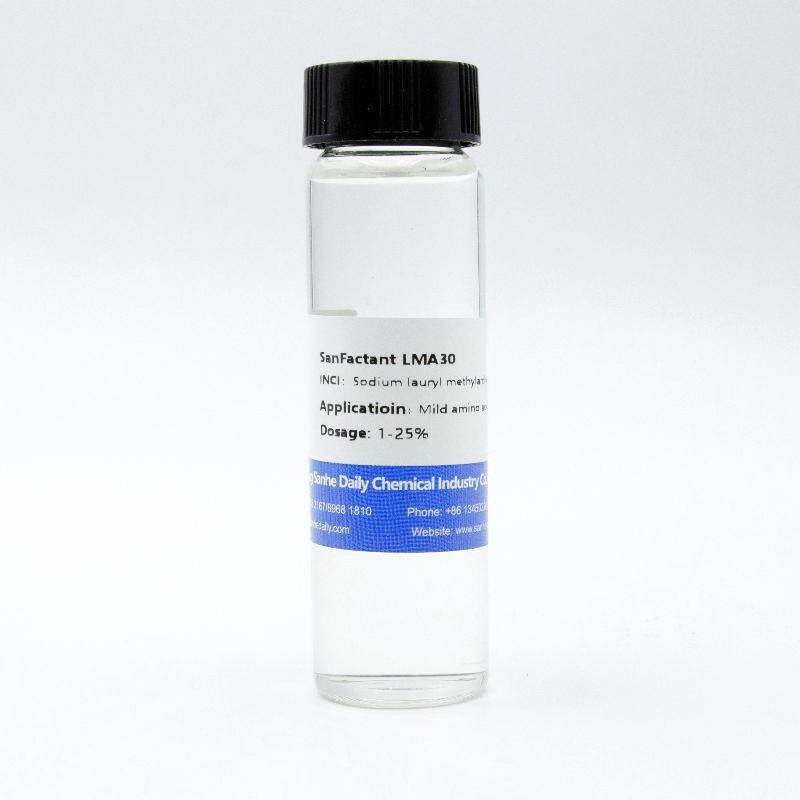
Sodium lauroyl methylaminopropionate is a mild amino acid surfactant. It has excellent foam in the formula. The foam is fine and rich, and has certain conditioning properties. It significantly improves the softness of dry hair. It can be used as the main surfactant in amino acid washing formulas or as an auxiliary surfactant.
Sodium cocoyl alaninate
Alaninates, a type of amino acid surfactants, possess exceptional cleansing properties. These surfactant molecules are formed by attaching alkyl groups to the nitrogen in amino acids, yielding compounds like alaninate.
Sodium lauroyl sarcosinate
Sodium lauroyl sarcosinate, also known as sarcosyl, represents an anionic surfactant derived from sarcosine. It serves as a crucial foaming and cleansing agent in various products, including shampoo, shaving foam, toothpaste, and foam washes. This particular surfactant demonstrates effective cleansing properties while remaining mild, safe, and non-irritating to the skin.
Sodium cocoyl glycinate
Sodium cocoyl glycinate, derived from plant oils and glycine—an amino acid, is a mild and versatile surfactant. Often found in hair care products, this multifunctional ingredient not only serves as a gentle and safe cleansing agent but also acts as an emulsifier, wetting agent, dispersing agent, and foam stabilizer in cosmetic formulations.
Sodium cocoyl glutamate
Derived from coconut oil and the amino acid glutamic acid, the surfactant sodium cocoyl glutamate boasts gentle cleansing properties. This mild surfactant creates a rich lather that effectively stabilizes bubbles, allowing them to persist for an extended period before dissipating.
Application fields of amino acid surfactants
The company conducted a competitive advantage analysis to identify its strengths and weaknesses compared to its rivals.
Personal care and cosmetics
Amino acid-based surfactants are prevalent in skincare and hair care products due to their mild and skin-friendly nature.
01
Food industry
In the food industry, it is mainly used as a food emulsifier, defoamer, sugar additive, cleaning agent, and fruit peeler. The most widely used is food emulsifier.
02
Leather industry
In the leather industry, it is mainly used as an emulsifier, dyeing assistant, and amphoteric fatliquor in leather making. It can also be used as a solvent resistant and dry cleaning resistant fatliquor separately.
03
Agricultural field
In the agricultural field, some amino acid surfactants can be used as pesticides, herbicides, plant growth inhibitors, etc. In agricultural production.
04
Anumfacturing and biochemical research
In the fields of drug anumfacturing and biochemical research, synthesized acyl amino acid peptides can be used as drug carriers for the preparation of functional liposomes with lipopeptide ligands.
05
Available in 25kg plastic buckets, 200kg plastic buckets, or 1000kg boxes packaging.
The packages can be customized as per your requirements.
It should be stored in a dry and cool place, not in the sun or near the heat source.
Surfactants are transported in different ways depending on the amount of surfactant being transported. Drums or IBC totes are commonly used to transport and ensure long-term storage of small quantities of liquid surfactants. However, liquid bulk transportation of industrial surfactants may use liquid bulk tank trucks. In this liquid bulk surfactant transportation process, thousands of gallons of chemicals are loaded into stainless steel insulated (SSI) tank trucks.
FAQ
We're professional amino acid surfactants suppliers in China, specialized in providing high quality products with low price. Please rest assured to buy customized amino acid surfactants made in China here from our factory. For free sample, contact us now.
SanFactant LMA30