

Exfoliants are a crucial part of skincare routines, designed to remove dead skin cells, unclog pores, and promote a smoother, more radiant complexion. Among the various ingredients used in exfoliants, carbomer resin has emerged as a key player due to its unique properties and versatile applications. As a leading supplier of carbomer resin, I am excited to delve into the diverse ways carbomer resin is utilized in exfoliants.
Rheology Modification
One of the primary applications of carbomer resin in exfoliants is rheology modification. Carbomer resin is a high - molecular - weight polymer that, when dispersed in water and neutralized, forms a viscous gel. This property is particularly useful in exfoliant formulations as it helps to control the flow and consistency of the product.

In physical exfoliants, which contain granular particles like sugar, salt, or microbeads, carbomer resin acts as a thickening agent. It suspends the exfoliating particles evenly throughout the product, preventing them from settling at the bottom of the container. For example, a sugar - based exfoliant would quickly separate if not for the presence of carbomer resin. The resin creates a stable matrix that keeps the sugar granules uniformly distributed, ensuring that each application delivers a consistent amount of exfoliation.
In chemical exfoliants, which use acids such as alpha - hydroxy acids (AHAs) or beta - hydroxy acids (BHAs) to dissolve dead skin cells, carbomer resin can adjust the viscosity to a level that is easy to apply and spread on the skin. It gives the product a smooth, creamy texture that enhances the user experience. This is especially important for chemical exfoliants, as a well - formulated product is more likely to be applied evenly, maximizing the effectiveness of the acids.
Emulsion Stabilization
Many exfoliants are formulated as emulsions, which are mixtures of oil and water. Carbomer resin plays a vital role in stabilizing these emulsions. It helps to prevent the separation of the oil and water phases, ensuring the product remains homogeneous over time.
When an exfoliant contains both oil - soluble and water - soluble ingredients, such as essential oils and water - based acids, carbomer resin acts as an emulsifier. It forms a protective layer around the oil droplets in the water phase, preventing them from coalescing and rising to the surface. This is essential for maintaining the integrity of the product and ensuring that all the active ingredients are evenly distributed.
For instance, in a moisturizing exfoliant that combines an oil - based emollient with a water - based exfoliating acid, carbomer resin ensures that the emollient is dispersed evenly throughout the product. This not only provides a smooth application but also allows the skin to receive both the exfoliating benefits of the acid and the moisturizing effects of the emollient simultaneously.
Skin Adhesion
Carbomer resin also enhances the skin adhesion of exfoliants. When applied to the skin, the gel - like structure formed by carbomer resin adheres to the skin surface, allowing the exfoliating agents to remain in contact with the skin for a sufficient period.
In physical exfoliants, the adhesion property helps the granular particles to stay on the skin during the exfoliation process. This ensures that the particles can effectively scrub away dead skin cells as the product is massaged onto the skin. In chemical exfoliants, the adhesion allows the acids to penetrate the skin more effectively. The longer the acid remains in contact with the skin, the better it can break down the bonds between dead skin cells, resulting in a more thorough exfoliation.
Controlled Release of Active Ingredients
Another significant application of carbomer resin in exfoliants is the controlled release of active ingredients. The gel matrix formed by carbomer resin can encapsulate the exfoliating agents, releasing them gradually over time.
In chemical exfoliants, this controlled - release mechanism is particularly important. It helps to prevent the sudden and excessive release of acids, which could cause skin irritation. By releasing the acids slowly, the skin has time to adapt to the exfoliating process, reducing the risk of adverse reactions.
For example, in an AHA - based exfoliant, carbomer resin can slow down the release of glycolic acid. This allows the acid to work gently on the skin, gradually removing dead skin cells without causing a sharp increase in skin sensitivity.
Our Carbomer Resin Products for Exfoliants
As a carbomer resin supplier, we offer a range of high - quality products suitable for exfoliant formulations. One of our popular products is SanCarbopol U20. SanCarbopol U20 is a cross - linked polyacrylate polymer that provides excellent thickening and suspending properties. It is ideal for physical exfoliants, as it can effectively suspend large exfoliating particles and maintain a stable product consistency.
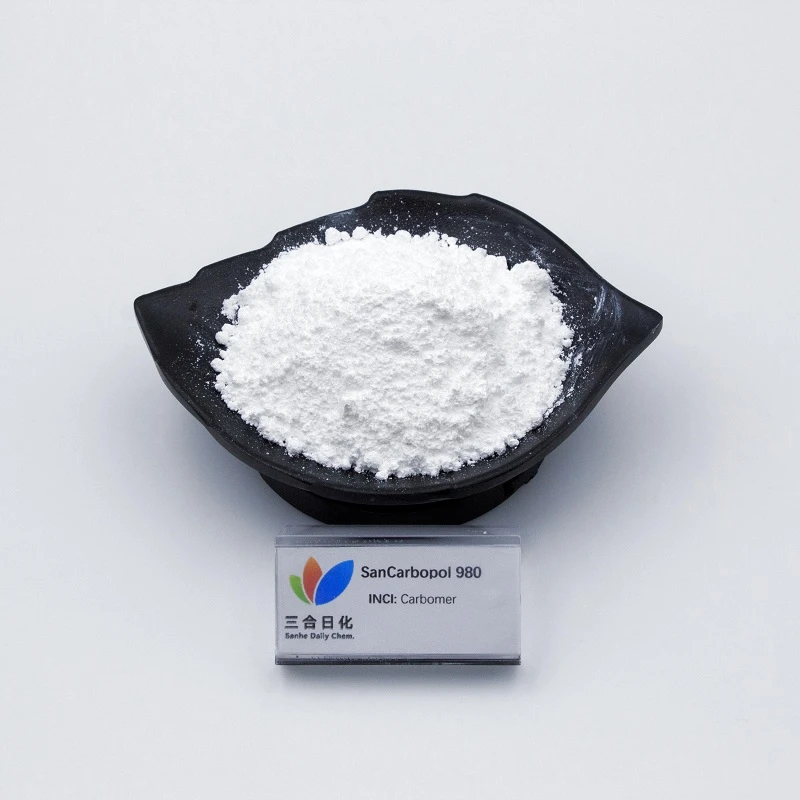
Another product is Carbomer SanCarbopol 980. Carbomer SanCarbopol 980 is a high - molecular - weight carbomer that offers superior rheology modification and emulsion stabilization. It is well - suited for both physical and chemical exfoliants, providing a smooth, creamy texture and ensuring the stability of the product.
In general, Carbomer resins are essential ingredients in modern exfoliant formulations. Their ability to modify rheology, stabilize emulsions, enhance skin adhesion, and control the release of active ingredients makes them indispensable for creating effective and user - friendly exfoliants.
If you are interested in incorporating carbomer resin into your exfoliant products, we invite you to contact us for a detailed discussion. Our team of experts is ready to assist you in selecting the most suitable carbomer resin for your specific formulation needs and provide you with all the technical support you require. We look forward to the opportunity to work with you and contribute to the development of high - quality exfoliant products.
References
- Cosmetics & Toiletries Magazine, various issues on ingredient technology in skincare.
- "Formulating Cosmetics" by Robert L. Davidson, a comprehensive guide on cosmetic formulation techniques.
- Research papers on carbomer resin applications in personal care products from academic databases such as ScienceDirect.